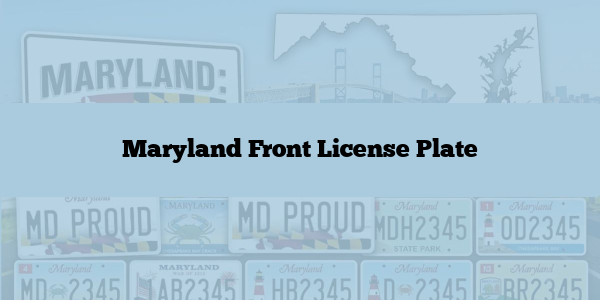
Operating a vehicle in Maryland comes with specific rules regarding vehicle identification. The state mandates that drivers display a registration plate on both the front and rear of their cars. This rule applies to the majority of passenger vehicles traveling on public roads. Failing to follow this mandate can lead to unwanted interactions with law enforcement.
The Maryland MVA enforces these regulations to ensure public safety and proper identification. A Maryland front license plate allows officers and automated systems to identify a car approaching from the opposite direction. It plays a critical role in toll collection, red-light enforcement, and Amber Alerts. Knowing these exact guidelines helps you avoid costly penalties.
Does Maryland Require a Front License Plate?
The state clearly dictates that a Maryland front plate requirement applies to most motor vehicles driven on state highways. The legal requirements leave little room for interpretation when it comes to standard vehicle classification.
Which Vehicles Must Display Two Plates?
Standard passenger cars, including sedans, hatchbacks, and SUVs, must show plates on both ends. All trucks, regardless of weight class, fall under the same legal requirements. Commercial vehicles used for business purposes, such as delivery vans and flatbed trucks, must also follow this rule. If the vehicle has a standard Maryland License Plate Types classification, it needs two tags.
Vehicles That May Be Exempt
Maryland law provides specific exemptions based on vehicle classification. Motorcycles are only issued a single rear registration plate because they lack a safe, structural front mounting area. Trailers, including boat trailers and utility trailers, also receive just one rear tag. Certain historic vehicles might qualify for an exemption if they were manufactured without a front bracket from the factory, though owners must provide proof of original manufacturing specifications. For drivers utilizing Maryland Temporary License Plate tags, the cardboard temporary tag usually goes in the rear window, exempting the front temporarily until metal plates arrive.
Maryland Front License Plate Laws
Maryland Transportation Article § 13-411 governs the display of these tags. The vehicle code states explicitly that registration plates must be attached to the vehicle for which they are issued. For exact legal statutes, residents can visit https://mva.maryland.gov/.
Maryland Transportation Laws
State traffic laws mandate that every registered vehicle, unless specifically exempted, must carry two plates. One must be on the front, and the other must be on the rear. The law prohibits swapping plates between vehicles or displaying tags from another state.
License Plate Display Rules
The tag must remain entirely unobstructed at all times. Compliance means keeping the plate free from any materials that block the letters and numbers. You cannot alter the plate in any way that changes its appearance to the naked eye or a camera.
Visibility Requirements
Law enforcement relies on clear visibility to read tags from a distance. The reflective material on the plate must be intact. The registration sticker, if applicable, must be clearly visible and not covered by tape or other objects.
Mounting Position
The front tag must sit horizontally. It cannot be tilted vertically or at an extreme angle. It needs to be fastened securely to the front bumper, not resting loosely on the dashboard inside the windshield.
Plate Condition Requirements
Drivers must maintain the physical condition of the tag. If a plate becomes heavily rusted, faded, or damaged, it violates state laws. The MVA expects drivers to initiate a Maryland License Plate Replacement request immediately when the condition degrades.
Maryland License Plate Display Requirements
Proper display goes beyond simply having the tag on the car. The state dictates exact specifications for how the plate interacts with the vehicle’s exterior to guarantee compliance.
| Feature | Requirement | Common Violation |
|---|---|---|
| Height | Parallel to ground | Extreme upward or downward angle |
| Frame | Leaves all text visible | Covers state name or numbers |
| Cover | Strictly prohibited | Tinted or smoked plastic covers |
| Condition | Clean, no cracks | Mud buildup, peeling paint |
Height and angle play a major role in compliance. The tag should sit parallel to the ground. Extreme upward or downward angles distort the numbers for automated cameras and make it difficult for officers to identify the vehicle.
Penalties for Driving Without a Front License Plate
Driving without the proper front tag is a citable offense in the state. Law enforcement takes display requirements seriously to maintain road safety and toll integrity.
Traffic Citation
Law enforcement officers have the right to pull over a vehicle solely for a missing front plate. This serves as a primary offense, meaning no other traffic violation is needed to initiate the stop. The officer will issue a formal citation on the spot.
Possible Fines
The standard base fine for missing a front tag in Maryland is $60. However, court costs and processing fees are added to this amount, bringing the total out-of-pocket expense closer to $90 for the driver.
Court Consequences
If the driver decides to contest the ticket in court, they risk additional court fees if the judge rules against them. Failing to pay the fine on time can result in a suspended driver’s license or additional collection fees.
Repeat Violations
Multiple citations for the same offense signal a pattern of non-compliance. While it remains a minor traffic offense, repeated violations can negatively impact a driver’s record and lead to higher insurance premiums. It is much cheaper to purchase a mounting bracket than to pay multiple penalties.
How to Install a Maryland Front License Plate
Securing the tag properly prevents it from falling off and ensures compliance with state laws. Installation is a straightforward process for most vehicles.
Required Tools
You will need a screwdriver (usually a Phillips head), the provided license plate screws, and the mounting bracket if the car did not come with one. Rust-resistant screws are highly recommended.
Step-by-Step Installation
First, align the plate over the factory holes on the front bumper. Next, insert the screws through the plate holes and into the bumper bracket. Tighten the screws firmly by hand, then give a slight twist with the screwdriver to ensure they do not vibrate loose while driving. Do not over-tighten, as this can crack the metal plate.
Vehicles Without Factory Mounts
Some modern cars do not include a drilled bumper. In this case, you must purchase an aftermarket mounting kit specific to your vehicle model. These kits usually attach to the lower grille using heavy-duty zip ties or existing factory clips. Drilling holes into a modern bumper without a factory bracket can cause damage and devalue the vehicle.
How to Replace a Missing or Damaged Front Plate
A lost or destroyed tag must be remedied immediately to remain legally compliant on the road. The Maryland MVA provides a simple process to obtain a new one.
When Replacement Is Required
You must apply for a new tag if your current one is stolen, heavily damaged, faded, or missing completely. Driving with a mangled or unreadable plate carries the same penalties as driving without one.
Replacement Process
To get a duplicate plate, you can visit any local Maryland DMV Locations branch. You will need to fill out a replacement application, provide your vehicle registration card, and show a valid driver’s license. If the plate was stolen, you should first file a police report and bring the report number to the MVA. For mail requests or specific questions, you can contact the MVA directly at mva.customerservice@maryland.gov.
Replacement Fees
The official fee for a substitute or duplicate registration plate in Maryland is $20. If you need both the front and rear plates replaced at the same time, the fee remains $20 for the set. There is no additional charge for the standard registration sticker that accompanies the new plates.
Front License Plate Rules for Special Vehicle Types
Different vehicle classifications carry unique rules regarding front tag display. Drivers of specialized vehicles must pay close attention to their specific registration category.
| Vehicle Type | Front Plate Rule | Required Documentation |
|---|---|---|
| Historic | Required unless factory exempt | Manufacturer specs |
| Commercial | Always required | Standard registration |
| Motorcycle | Exempt | Rear plate only |
| Trailer | Exempt | Rear plate only |
Historic Vehicles
Vehicles registered with historic tags generally must follow the two-plate rule unless the specific make and model lacked a front mount from the factory. Owners must provide manufacturer documentation to prove this exemption to the MVA.
Commercial Vehicles
Commercial registration rules are strict. All commercial trucks and vans must display a front plate. This ensures toll compliance and accurate tracking for Department of Transportation weight stations.
Government Vehicles
State and local government vehicles follow the same two-plate mandate as civilian cars. Federal government plates also follow this standard to maintain uniform identification across jurisdictions.
Dealer Vehicles
Car dealerships use special dealer tags. These are typically magnetic or plastic and must be displayed on the front and rear of the vehicle during test drives.
Temporary Tags
When a car is newly purchased, it receives temporary registration. This cardboard tag is placed in the rear window, temporarily exempting the vehicle from the front plate rule until the permanent metal plates are mailed by the MVA.
Mistakes Drivers Make
Many drivers fail basic compliance due to simple, avoidable errors. Being aware of these pitfalls keeps you safe from citations.
Using tinted or decorative covers is a massive mistake. These accessories block cameras and guarantee a citation. Incorrect mounting, such as placing the tag on the dashboard, is illegal because the windshield glass reflects light and distorts the numbers. Missing screws cause the plate to flap in the wind, which police view as an intentional attempt to obscure the tag. Driving with dirty plates covered in mud or road salt hides the registration sticker. Finally, folded or bent plates are unreadable and require immediate replacement. Avoiding these errors keeps your Maryland License Plate Renewal status in good standing.
Frequently Asked Questions
Get clear answers to the most common questions regarding Maryland vehicle titling, registration costs, and state taxes. This section breaks down the official weight-based fee structures and replacement rates to help you calculate your exact MVA costs without any unexpected surprises.
Does Maryland require a front license plate?
Yes, Maryland law strictly mandates that the vast majority of motor vehicles, including standard passenger cars, SUVs, pickup trucks, and commercial vehicles, must display a registration plate on both the front and rear bumpers. If the Maryland Motor Vehicle Administration (MVA) issues you a set of two physical metal plates during your registration process, you are legally required to mount both of them. Failing to do so violates state compliance rules, as the dual-plate system is used heavily by law enforcement for two-way vehicle tracking and state electronic video tolling systems.
Can I drive without a front plate?
No, operating a vehicle registered in Maryland without its designated front tag is a direct violation of Maryland Transportation Code § 13-411. While recent traffic enforcement updates have shifted how police pull drivers over, it remains a misdemeanor traffic infraction to drive on any public highway without displaying proper front and rear registration tags. If your vehicle is parked on public property or involved in an accident, the missing front plate will instantly flag your vehicle for a citation and non-compliance fines.
What is the fine for missing a front plate?
The standardized prepayment fine for an improperly displayed or missing license plate in Maryland is exactly $70. However, if you choose to contest the ticket in traffic court and lose, a judge has the legal authority to increase the misdemeanor financial penalty up to a maximum of $500. It is highly recommended to pay the $70 prepayment penalty or fix the tag immediately, as unpaid traffic citations will lead to the suspension of your vehicle’s registration and a hold on your MVA account.
Are motorcycles required to display a front plate?
No, motorcycles are explicitly exempt from the state’s two-plate requirement under Maryland vehicle law due to their obvious structural and manufacturing limitations. Owners of motorcycles, as well as those registering standard pull-behind trailers or semi-trailers, are only issued a single registration tag by the MVA, which must be securely fastened to the rear of the vehicle. For these specific vehicle classes, keeping that single rear plate clean, illuminated, and clearly legible satisfies all state traffic requirements.
Can I mount my plate on the dashboard?
No, placing your front license plate inside the windshield or propping it up on the dashboard is strictly illegal under Maryland traffic regulations. The law demands that the plate must be securely fastened externally to the actual front bumper area of the vehicle in a completely horizontal, non-swinging position. Glass windshields create heavy sunlight glare and reflections that completely obscure the plate’s characters, making it virtually unreadable to law enforcement officers, automated speed traps, and toll cameras.
Can I use a plate cover?
No, Maryland enforces an absolute ban on all forms of registration plate covers under Transportation Code § 13-411.1, making it illegal to display or even sell them. This strict law covers any clear, tinted, colored, smoked, or illuminated plastic frames designed to clip over your state-issued license plate. Because these covers distort camera images and reduce the reflectivity of the tag’s background material, using one will result in an immediate traffic citation, even if the plate numbers underneath are technically visible to the naked eye.
Are temporary tags exempt?
Yes, but this exemption is completely temporary and applies only while your initial short-term registration permit is active. When you buy a new or used vehicle, the MVA or an authorized dealership will provide a secure 30-day paper temporary tag that must be displayed strictly in the rear window facing outward. You are completely exempt from the front bumper plate rule during this 30-day inspection window, but you must mount your permanent metal front plate the exact day it arrives in the mail.
How do I replace a damaged front plate?
To replace a front license plate that has been stolen, lost, or bent out of legibility, you must submit an application for substitute tags using MVA Form VR-009. The state charges a standard $20 replacement fee to process a duplicate set of plates and provide you with a fresh set of registration stickers. You can complete this transaction by visiting a full-service MVA branch in person or mailing the application along with your old remaining plate to the central Glen Burnie office.
Can I transfer my front plate?
No, you cannot legally swap or transfer a front license plate directly from one vehicle to another on your own, as plates are strictly assigned to a specific vehicle identification number (VIN). If you sell your automobile, the physical plates must either be surrendered back to the MVA or formally transferred to your new car via an official MVA registration application. Unauthorized plate swapping is considered a serious fraudulent offense in Maryland and can result in severe vehicle impoundment and heavy court fines.
What vehicles are exempt?
Aside from motorcycles and standard tow trailers, the primary exemptions to the two-plate rule apply to specific classifications of registered historic vehicles and vintage street rods. Specifically, Class L (Historic) and Class N (Street Rod) vehicles that are older than 50 years are legally permitted to display only a single rear registration plate under Maryland law. For newer historic cars, you are still required to display both plates unless you apply for an official MVA waiver proving the vehicle lacks a physical factory mounting location.
Is a front bracket required?
While the law doesn’t specifically mandate a factory-brand bracket, it states that the license plate must be securely fastened and completely level on the front bumper. If your car was manufactured without a built-in front plate holder, you are still required to buy an aftermarket bracket or a universal tow-hook mounting kit to display the tag legally. Note that Maryland auto dealers are legally required to equip new vehicles with a front license plate bracket before delivery unless the buyer signs a formal refusal waiver.
Can police stop you for a missing front plate?
No, not as a primary reason. Under Maryland’s updated secondary enforcement laws, a missing front license plate or an improper plate display is classified as a secondary offense. This means a police officer cannot legally initiate a traffic stop solely because your front tag is missing if you are driving safely. However, if they stop you for a primary violation—such as speeding, running a stop sign, or texting while driving—they can absolutely tack on the $70 missing plate fine to your ticket.